
Following the state visit of the American president earlier this year, in a ten-part series historian and honours expert Russell Malloch looks at the recent history of state visits in the UK. In this article, he explores how state visitors were welcomed on their arrival.

Chapters
State visit conventions
The state visits to the United Kingdom that have taken place since the start of the 20th century have typically been based at Buckingham Palace in central London or at Windsor Castle in Berkshire. They have engaged the sovereign and their family, together with officials from the royal household, members of the armed services and police forces; government ministers; civic leaders from London, Windsor and elsewhere; representatives of the diplomatic corps; and organisations that provide catering, transport, and a wide range of other services.
The programme for a Buckingham Palace visit usually included the following elements:
- the reception of the head of state by a member of the royal family on their arrival by sea or air, followed by an inspection of guards of honour and gun salutes
- the receipt of addresses of welcome from mayors and other civic leaders
- an initial meeting with the sovereign, usually at Victoria Railway Station, and later at Horse Guards, with a second guard of honour inspection
- a carriage procession from Victoria or Horse Guards to the palace
- an exchange of honours and presents
- a state banquet at the palace
- the reception of senior foreign diplomats in London
- a meeting with the prime minister, and entertainment provided by the British government
- an address of welcome and banquet given by the lord mayor of London at Guildhall
- a return banquet or entertainment provided by the visiting head of state
This basic arrangement has been supplemented with visits to individual members of the royal family, and the grave of the Unknown Warrior; trips to cultural, commercial and military events; and visits to other parts of the United Kingdom, including Belfast, Cardiff and Edinburgh.
Arrival
All of Edward VII’s guests arrived by sea, starting with Emile Loubet of the French Republic (Gazette issue 27575), who landed at Kent on 6 July 1903, when he received a welcome address from the local civic body, consisting of the mayor and corporation of Dover.
The main welcome party for President Loubet consisted of a member of the royal family, the county lieutenant, and a few senior military and civic personnel. The French guest was met by the King’s brother Arthur, Duke of Connaught, who was accompanied by Lord Stanhope, the lord lieutenant of Kent (Gazette issue 26034); Sir Evelyn Wood, the field-marshal commanding the Second Army Corps; and Major-General Leslie Rundle, the officer in charge of the South Eastern District.
Portsmouth replaced Dover as the preferred landing point for most of Edward VII’s visitors, and so that port was used for King Victor Emmanuel of Italy in 1903 (Gazette issue 27620), as well as later visits by Kings Alfonso of Spain, through to Manuel of Portugal in 1909 (Gazette issue 28311). Dover was brought back into action for a few later landings, as with Raymond Poincare of France in 1913, Hirohito of Japan in 1921, and the Kent port was the usual destination for most of George VI’s guests, who continued to arrive by sea.
During Elizabeth II’s reign, air travel took over from a sea voyage as the favoured means of transport, but Dover continued to serve as a state visit port, and was used for Giovanni Gronchi of Italy in 1958 and William Tubman of Liberia in 1962.
A number of other landing points were used, and Elizabeth II’s first guest, Gustaf VI Adolf of Sweden, arrived at Greenwich on the Swedish cruiser Tre Kronor. There were even a few landings at Leith near Edinburgh, for Olav V of Norway who disembarked from the royal yacht Norge in 1962, as did his son Harald V in 1994.

Air became the dominant form of travel during the 1950s, with the majority of heads of state arriving at Gatwick, Heathrow or Stanstead airports near London, or at one of the Royal Air Force bases close to the capital. The first airborne guest was Theodor Heuss of Germany who landed at Gatwick in 1958, when the welcome party was similar to that for arrivals at sea ports, and consisted of the lord lieutenant of Surrey, the general officer commanding Eastern Command, and the air officer commanding Home Command, while the naval guard of honour from Dover was replaced by a Royal Air Force unit.
The programme began to alter in the 1980s, when the head of state was initially greeted by a senior household official, rather than a member of the royal family. The visitor would then spend their first night in a hotel or at their embassy in London, before the more formal ceremonial began.
The first visitor for whom this procedure was implemented was Hassan II of Morocco who stayed in Brighton in July 1987, at the Grand Hotel, which was an unusual choice of venue, as it recalled the carnage three years earlier, when the provisional Irish republican army tried to assassinate the prime minister. King Hassan was welcomed the next day in Brighton by the sovereign’s cousin, Princess Alexandra of Kent, who then travelled with him by train to meet the Queen at Victoria Railway Station in London.
Since 2000, most heads of state have had an overnight stay at one of London’s principal hotels, including Claridge’s and the Dorchester, before meeting the sovereign. A few used their ambassador’s residence for the first night, as happened with the American president Donald Trump, who stayed at Winfield House in Regent’s Park in 2019 and 2025.
The “overnight stay” visitors were welcomed when they first set foot in the United Kingdom by one of the lords in waiting, and so Lord Faringdon (Gazette issue 58729) was asked to meet Roh Moo Hyun of South Korea at Heathrow on 30 November 2004. The president then stayed at the London Hilton Hotel, where the Queen’s son Edward, Earl of Wessex, formally welcomed him at the start of his state visit.
Similar “lord in waiting” services were rendered by Viscount Brookeborough at Heathrow for John Kufuor of Ghana in 2007 and at Stansted for the King of Spain in 2017, while Viscount Hood welcomed Xi Jinping of China at Heathrow in 2015, and the King of the Netherlands at RAF Northolt in 2018. Donald Trump was met at Stanstead in 2019 by Lord Brookeborough, and by Lord Hood in 2025, after he landed at the same airport on Air Force One.
Royal welcome
The task of formally welcoming the head of state to the United Kingdom was always assigned to a senior member of the royal family. In 1903 President Loubet was greeted by King Edward’s brother Arthur, Duke of Connaught, who also received Woodrow Wilson at Dover, at the start of the first visit by an American president, which happened in December 1918, shortly after the armistice. The duke’s son, Prince Arthur of Connaught, performed similar duties for the arrival of King George of Greece in 1905 (Gazette issue 27859), and Armand Fallieres of France in 1908 (Gazette issue 28141).
The job was often delegated to the Prince of Wales, with the future kings George V and Edward VIII welcoming guests ranging from the German Emperor in 1907 to Amanullah of Afghanistan in 1928. King George VI called on the services of his brother Henry, Duke of Gloucester, who met visitors from Leopold of the Belgians in 1937 through to Haakon of Norway in 1951, while his younger brother George, Duke of Kent, received Carol of Romania in 1938.
During Elizabeth II’s reign the task was performed on more than 20 occasions by her heir apparent, now King Charles III, starting in July 1975 with King Carl Gustaf of Sweden at RAF Turnhouse, as his visit was based at the Palace of Holyroodhouse. The then Prince of Wales also welcomed three American presidents: George W. Bush in 2003 and Donald Trump in 2019 at Buckingham Palace, and Barack Obama at Winfield House in 2011.
William, Prince of Wales, continued the family tradition, starting in 2014 when (while still Duke of Cambridge) he acted for his grandmother in welcoming Tony Tan of Singapore at the Royal Garden Hotel in London. He also joined Cyril Ramaphosa of South Africa at the start of the first state visit of his father’s reign in November 2022, and performed a similar duty for Donald Trump in 2025.
Other royal welcomes were delivered by Princess Anne, later the Princess Royal, who embarked on this role in 1979 for Daniel arap Moi of Kenya. She also received Hastings Banda of Malawi at Heathrow in 1985, and Nelson Mandela of South Africa at the Dorchester Hotel in 1996. Princess Margaret, Countess of Snowdon, performed the task for Baudouin of the Belgians in 1963, through to the arrival of Jacques Chirac of France, who arrived on the Eurostar train at Waterloo International Station in 1996.

Foreign suite
The visitor was always accompanied by an official suite, consisting of between 5 and 20 individuals, with a membership that ranged from close relatives to the prime minister, foreign minister and/or other members of the government. The foreign minister usually ranked as the senior member of the suite.
The 2003 arrivals demonstrated the variation in the composition of the foreign suite, as Vladimir Putin of Russia was joined by his deputy prime minister and foreign minister, along with seven other members, including the mayor of Moscow, Yury Lushkov, and the governors of the Leningrad and Novgorod regions. Five months later, President Bush arrived with a party that included the American secretary of state, Colin Powell, and the assistant for national security affairs, Condoleezza Rice.
During subsequent American visits, Barack Obama was joined by Hillary Clinton as secretary of state in 2011, and eight years later the senior member of Donald Trump’s suite was Steven Mnuchin, the secretary to the Treasury, along with Jared Kushner as a special adviser. In 2025 the presidential party reverted to the secretary of state, Marco Rubio, while the other members of the Trump suite included Scott Bessent, the secretary of the Treasury, and Steve Witkoff, the special envoy for peace missions, who was involved in trying to negotiate settlements in Gaza and Ukraine.
The foreign suite often included protocol personnel, the principal private secretary and members of the visitor’s household, as well as aides de camp, doctors, press staff, and security officers. The visitor was also joined by a “local” contingent of foreign personnel, including their ambassador or high commissioner, and senior embassy staff in London.
The visit occasionally gave rise to the need for translators to take part, as happened during the historic visit of Hirohito of Japan in 1971, when the three individuals in the procession to Buckingham Palace consisted of the Queen, the Japanese emperor, and their interpreter Tatsuo Arima in the first carriage, along with the Duke of Edinburgh, Empress Nagako and a second interpreter, Akiko Arishima, in the second.
The Court Circular carefully excluded the names of Mr Arima and Madame Arishima from the narrative, and so provided a timely reminder of the constant need for care in accepting official reports as conveying an accurate account of who and what was involved on state occasions.
As regards the presence of the visitor’s children and their spouses, the late Queen welcomed foreign suites that included the daughters of Ayub Khan of Pakistan in 1966, Kenan Evren of Turkey in 1988 and Ramaswamy Venkataraman of India in 1990. The sons of several presidents also participated in the ceremonial, among whom the sons of Abdou Diouf of Senegal in 1988 and Hosni Mubarak of Egypt in 1991. Donald Trump followed the family precedents, and in 2019 he was accompanied by his daughter Tiffany and his daughter in law Mrs Lara Trump, while his 2025 suite included his sons Donald and Eric Trump.
British suite
At the start of each state visit, the guest was introduced to a small group of individuals who had the job of assisting the monarch or president during the stay, and constituted the British suite in attendance. The group usually included a lord and lady in waiting, an equerry, and members of the armed services. For the first of the Edwardian arrivals in 1903, the French president was joined by the Earl Howe as the lord in waiting (Gazette issue 27243), and Captain Seymour Fortescue as the equerry in waiting (Gazette issue 27288), together with a vice admiral and a major general.
Up until the 1960s, it was customary for the British suite to include the United Kingdom’s air, military and/or naval attaches in the visitor’s country, and prior to 1972 the group also included an officer from the armed forces of three or four-star rank. The soldiers who were attached to guests at the start of Elizabeth II’s reign included a few more senior personnel, as Field-Marshal the Earl Alexander of Tunis (Gazette issue 36822), accompanied Charles de Gaulle of France in 1960, and Field-Marshal the Viscount Slim (Gazette issue 38500) joined King Mahendra of Nepal in 1961, while Admiral of the Fleet the Lord Fraser of North Cape was assigned to King Olav of Norway in 1962 (Gazette issue 38458).
Some royal equerries served on more than one British suite during their short time in the royal household, as with Lieutenant-Commander Toby Williamson (Gazette issue 55247) who accompanied Nelson Mandela in 1996, and five other heads of state, including Ezer Weizman of Israel and Emperor Akihito of Japan.
Another equerry, Timothy Laurence of the Royal Navy (Gazette issue 50833), was a member of seven British suites, helping to assist during the state visits of the kings of Morocco, Norway and Saudi Arabia, the presidents of Nigeria, Senegal and Turkey and the ruler of the United Arab Emirates. A few years later Commander Laurence became the husband of the Princess Royal, and so was a member of the royal family, rather than a more modest equerry, when later heads of state from Norway, Saudi Arabia and the United Arab Emirates attended their state banquets.
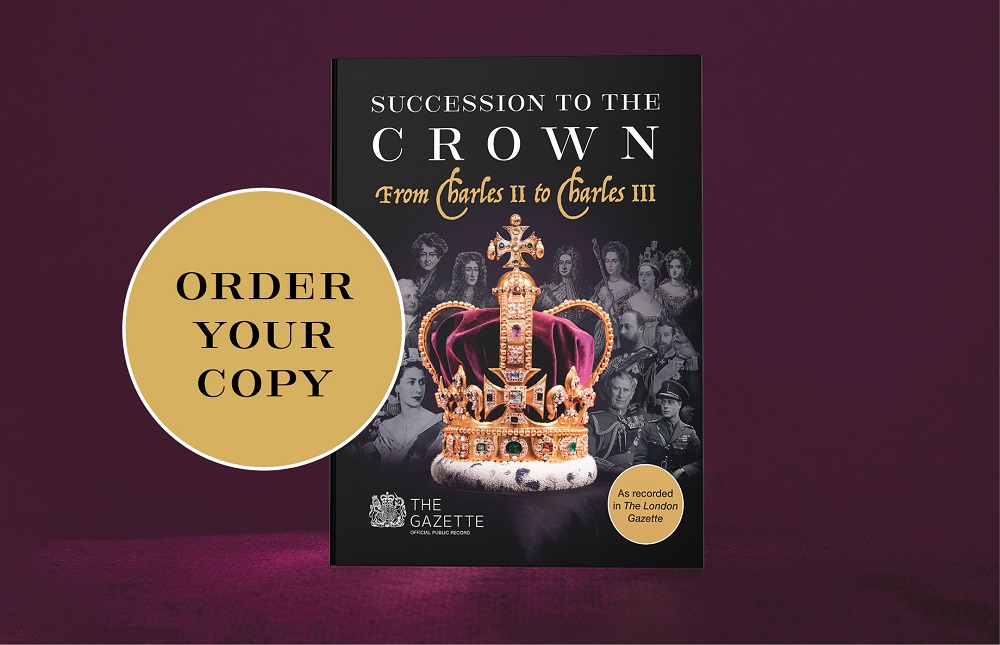
Succession to the Crown: From Charles II to Charles III
Succession to the Crown is essential reading for anyone with a keen interest in the British royal family and provides an excellent and trusted source of information for historians, researchers and academics alike. The book takes you on a journey exploring the coronations, honours and emblems of the British monarchy, from the demise of King Charles II in 1685, through to the accession of King Charles III, as recorded in The London Gazette.
Historian Russell Malloch tells the story of the Crown through trusted, factual information found in the UK's official public record. Learn about the traditions and ceremony engrained in successions right up to the demise of Queen Elizabeth II and the resulting proclamation and accession of King Charles III.
Available to order now from the TSO Shop.
About the author
Russell Malloch is a member of the Orders and Medals Research Society and an authority on British honours. He authored Succession to the Crown: From Charles II to Charles III, which explores the coronations, honours and emblems of the British monarchy.
See also
Demise of the Crown: #1: An introduction
Find out more
Succession to the Crown: - From Charles II to Charles III opens new window (TSO shop)
Images
- Photograph of Queen Elizabeth II who offers her hand in greeting President Mobutu (1930-97) of the Republic of Zaire (now the Democratic Republic of the Congo) on his arrival at Victoria Station, London. (Royal Collection Trust / © His Majesty King Charles III 2025)
- Queen Elizabeth II (left), King Olav of Norway (centre) and HRH The Duke of Edinburgh arriving at the Royal Lyceum Theatre on the second day of King Olav's State Visit to Edinburgh. (Royal Collection Trust / © His Majesty King Charles III 2025)
- President Daniel Arap Moi of Kenya talks to HM the Queen Mother before the State Banquet held in his honour at Buckingham Palace on the first night of his State Visit. (Royal Collection Trust / © His Majesty King Charles III 2025)
- The Gazette
Publication date
10 December 2025
Any opinion expressed in this article is that of the author and the author alone, and does not necessarily represent that of The Gazette.