
State visits and The Gazette: Part 10 - Regional events
Following the state visit of the American president in 2025, in a ten-part series historian and honours expert Russell Malloch looks at the recent history of state visits in the UK. In the final article of the series, he explores the events attended by monarchs and presidents that took place outside of London and Windsor.

Chapters
London and Windsor provided the setting for most of the ceremonial and other events that were organised for a foreign monarch or president during their state visit to the United Kingdom, but a few arrangements were designed to allow the guest to see what was happening in other parts of the realm.
Oxford and Cambridge were popular destinations for this purpose, because of their academic institutions and their ease of access from London, while the other English locations that were used for some guests included:
- Bath for Emperor Haile Selassie of Ethiopia in 1954 and Ramaswamy Venkataraman of India in 1990.
- Coventry for Michael Higgins of Ireland in 2014.
- Liverpool for John Kufuor of Ghana in 2007.
- Manchester for Woodrow Wilson of the United States of America in 1918, and a number of later heads of state, including Xi Jinping of China in 2015.
Scotland helped on a number of occasions, with the northern capital being the most popular destination, involving visits to Edinburgh Castle, and entertainment provided by the lord provost and/or the government. The more recent visits to the capital have included diversions for Queen Margrethe of Denmark in 2000, and Vladimir Putin of Russia in 2003.
Glasgow was chosen a few times. Raymond Poincare of France receiving the freedom of the city in 1919, and the city was visited by Kings Olav and Harald of Norway, and by presidents such as Giuseppe Saragat of Italy in 1969, Jacques Chirac of France in 1996, and Thabo Mbeki of South Africa in 2001. Two central American presidents travelled to Aberdeen, which reflected that city’s close links with the oil industry, with the most northern destination on the state visit circuit welcoming presidents Calderon and Nieto of Mexico in 2009 and 2015.
There were also visits to Wales and Northern Ireland. Richard von Weizsacker of Germany and Emperor Akihito of Japan travelled to Cardiff in 1986 and 1998, while Juan Santos of Colombia crossed to Belfast, where the signs of the Northern Ireland peace process were evident, as he met Arlene Foster, the first minister, and her deputy Martin McGuiness at Stormont Castle, before having lunch at the Titanic complex. The Belfast trip was also timely, given that it took place only weeks after President Santos was awarded the Nobel Peace Prize for his efforts in trying to end the 50-year-old civil war in Colombia.
Apart from the major cities, the more unusual locations were selected for visits by foreign heads of state included:
- Peterborough for Queen Beatrix in 1982, when she opened the Queensgate Centre, visited an exhibition about East Anglia’s links with the Netherlands, and had lunch with the Development Corporation, before going to the East of England Agricultural Society’s Show.
- Shinfield Park for Hastings Banda of Malawi in 1985, who saw the Reading Cattle Breeding Centre, and had lunch with the Royal Berkshire County Council.
- Milton Keynes for Ibrahim Babangida of Nigeria in 1989, where he had lunch with the mayor in the Civic Offices.
There were even a number of private house visits, as King Carl Gustaf of Sweden had lunch with the Countess of Mansfield at Scone Palace, before visiting the Scone Estates and Braco Hill Farm in 1975; Danial Arap Moi of Kenya lunched with the Duke of Norfolk at Arundel Castle, after visiting Dales Farm in Sussex and before touring West Stoke Farm near Chichester in 1979; and Jacques Chirac was entertained by the Earl of Shelburne at Bowood House after a visit to Dartmouth.
Companion visits
Where the principal visitor was joined by their wife, husband or other companion, a series of events were often made to run in parallel with the state occasions.
One popular choice was a visit to the Great Ormond Street Hospital for Sick Children, which welcomed the first ladies of Brazil, France and Portugal, among others. There were trips to several institutions that specialised in the delivery of health care and welfare services, such as:
- the premises of the St John Ambulance Association for the first lady of Nigeria.
- the international headquarters of the Salvation Army for Mrs Eanes of Portugal.
- the Stoke Mandeville Hospital for the wife of the Mexican president.
The less conventional venues for spouses to visit include:
- Basingstoke Shopping Centre, for the wife of Lech Walesa of Poland in 1991.
- Ditchley Park, where the first lady of Mexico saw the set of the television series Downton Abbey in 2015.
- Fairford in Gloucestershire, where Prince Bernhard of the Netherlands visited the British Aircraft Corporation’s Concord Project in 1972.
- Gloucester Walk in London, where Eeva Ahtisaari of Finland unveiled a plaque to the Finnish composer Jean Sibelius in 1995.
- the Scottish Tartan Society’s Museum in Edinburgh, which Christiane Herzog of Germany toured in 1998.

Reciprocation
The visiting monarch or president almost always returned the hospitality they received at the state banquet at Buckingham Palace or Windsor Castle, and laid on a banquet in honour of the sovereign and their consort.
Queen Elizabeth and the Duke of Edinburgh attended dozens of return dinners, which were generally staged at the visitor’s embassy, or at the residence of their ambassador, or at one of the principal London hotels. The ‘visitor’s banquet’ was often on the last full day of the inward state visit, and on the evening of their departure from the United Kingdom.
Claridge’s Hotel was the most popular location for the visitor’s banquet, although a number of other London hotels and venues were chosen. Nelson Mandela used the Dorchester Hotel to host his return dinner in 1996, and the Savoy was selected by the governments of Liberia and Nigeria, while King Abdullah of Jordan and Vladimir Putin of Russia used Spencer House in Westminster in the early years of the 21st century.
The Dutch queens Juliana and Beatrix hosted their return events at Carpenters’ Hall in 1972 and at Hampton Court Palace in 1982, with the Victoria and Albert Museum being used by Francesco Cossiga of Italy in 1990 and Emperor Akihito of Japan in 1998. Other locations used included the Royal Automobile Club in Pall Mall, and the Natural History Museum.
Very few of the return banquets were held outside London, apart from Arpad Goncz of Hungary who used the services of the Compleat Angler Hotel at Marlow in 1999, while the Royal Yacht Norge in the port of Leith provided the venue for Kings Olav and Harald of Norway when they were based at the Palace of Holyroodhouse.
The Court Circular indicates that the visitor’s banquet was usually dispensed with after March 2005, when the Queen and the Duke of Edinburgh were entertained by Cario Ciampi of Italy at his ambassador’s residence in Grosvenor Square. This change in the state visit programme presumably reflected the demands that such functions placed on the welfare of a more elderly sovereign and her husband.
Departure
The Court Circular routinely reported that the head of state took leave of the sovereign at Buckingham Palace or Windsor Castle, whether at the end of their state visit, or on the completion of any public and private engagements that took place after the palace and Guildhall banquets.
Before the start of Elizabeth II’s reign, it was usual for the sovereign to accompany their guest to Victoria Railway Station, where they would begin their onward journey home by train and sea. This practice applied during George VI’s reign, when the sovereign personally said goodbye to Kings Leopold of Belgium and Carol of Romania, and to presidents Lebrun and Auriol of France when they left for Dover. Such a procedure did not arise for the last visit of the reign in 1951, when King Haakon of Norway left on the Royal Yacht Norge from Chatham.
The first visitor to depart by air rather than sea was Queen Juliana of the Netherlands, who flew from Northolt Airport to The Hague in November 1950.
The farewell event was delegated to a member of the royal family for the first visits of the Elizabeth II’s reign, starting in 1954, when the Duke of Edinburgh accompanied the King of Sweden when he left, and the Queen’s uncle, the Duke of Gloucester, bade farewell to the Emperor of Ethiopia.
In later years the majority of visitors were driven to one of the principal London airports, where the lord chamberlain performed the job on behalf of the sovereign, a duty that two of the Queen’s chamberlains, the Earl of Airlie and the Earl Peel, carried out on many occasions, from 1985 when Airlie attended Hastings Banda of Malawi at Heathrow, through to 2019 when Peel took leave of Donald Trump at Southampton Airport.
Less frequently the job was assigned to one of the ordinary or permanent lords in waiting, and so the Earl of Westmorland, for example, took on this role in 1959 when the Shah of Iran left from RAF Northolt, and in 1960 when King Bhumibol of Thailand went to London Airport.
There were a few occasions on which the job was given to the sovereign’s local county representative, as in 1956 when the lord lieutenant of Kent attended King Faisal of Iraq at Lydd Airport, while the lord lieutenant of Lancashire accompanied William Tubman of Liberia when he boarded the ss Aureol at Liverpool in 1962, and the lord lieutenant of Oxfordshire parted from Carlo Ciampi of Italy at RAF Brize Norton in 2005. The prime minister, Harold Macmillan, was present on the departure of President de Gaulle in 1960.
A similar form of farewell ritual was retained for the inward state visits of King Charles III’s reign, and so Peel’s successor as lord chamberlain, Lord Parker of Minsmere, bade farewell to Cyril Ramaphosa of South Africa at Stansted in 2022, and also saw off the Emperor of Japan at RAF Brize Norton in 2024. The next chamberlain, Lord Benyon, accompanied Emmanuel Macron of France when he left from RAF Northolt in July 2025, and was with Donald Trump as he flew from Stansted in September 2025.
The flight plans connected with the inward state visits provide one of the few aspects of the process that occasionally featured in 21st editions of The Gazette, as the government used its powers to regulate the use of the air space, and a series of statutory instruments were made by the relevant government department.
This type of regulation was made in anticipation of the arrival of Barak Obama, as the secretary of state for transport deemed it necessary “in the public interest to restrict flying in the vicinity of central London, by reason of a state visit by the President of the United States of America that is scheduled to take place during the period from 23rd to 26th May 2011” (Gazette issue 59851).
A similar statutory instrument – The Air Navigation (Restriction of Flying) (State Visit by the President of the United States of America) Regulations 2025 – was made by the transport secretary on 15 September 2025, to restrict flying in the vicinity of Stansted Airport, a corridor between Stansted and London, within the vicinity of London and Windsor, a corridor between Windsor and Buckinghamshire, an area in Buckinghamshire, and a corridor between Buckinghamshire and Stansted. This was part of the overall security arrangements for Donald Trump’s visit, as the Civil Aviation Authority and the Department for Transport agreed that it was in the public interest that flying should be restricted in the relevant areas for reasons of public safety and security.
Similar orders were made by the government and/or local authorities to regulate the use of roads, railways and other parts of the national infrastructure during state visits, but they are not known to have been reported in The Gazette.

Trump precedent
The visit of a foreign head of state almost always gave rise to differences in opinion as to the wisdom of the invitation being issued by the British government, with displays of public support for the sovereign and their guest being matched by protests against the visitor’s domestic and international policies.
Donald Trump’s visit in 2025 attracted both positive and negative reactions from the public. In his speech at the state banquet, the King described the occasion as “unique and important”, and some commentators objected to what they thought was a favoured treatment, noting that earlier American presidents had received nothing other than tea during their second visit to the United Kingdom.
The King’s invitation letter accurately referred to the proposed visit being unprecedented “by a U.S. president”, rather than “in the history of state visits”, while the press overlooked the fact pattern that distinguished President Trump’s second banquet with Barack Obama having lunch with the Queen at Windsor Castle when he returned in 2016, and Donald Trump having tea with the Prince of Wales at Clarence House in December 2019, when he was in London, rather being received by the late Queen for a second state visit so soon after his June trip.
A key feature in the ritual is that the state visit is usually arranged between monarchs and presidents, rather than by nation states, and so Donald Trump’s visit in June 2019 was at the invitation of Queen Elizabeth, while the 2025 invite came from King Charles and Queen Camilla.
What would have been more unusual was a second banquet with the same host, an event that had few precedents since the start of the modern state visit routine began in Edward VII’s reign, as the only heads of state who paid two visits to the same sovereign were:
- Raymond Poincare of France, who visited George V in 1913 and 1919.
- Queen Margrethe of Denmark, who was the guest of Elizabeth II in 1974 and 2000.
- King Olav of Norway, who came to Edinburgh in 1962 and Windsor in 1988.
- King Harald of Norway, who visited the late Queen in 1994 and 2005.
A few heads of state also conformed to the “Trump pattern”, as they paid two state visits to the United Kingdom, but to different sovereigns, as with:
- King Victor Emmanuel of Italy, to Edward VII in 1903 and George V in 1924.
- Crown Prince and later Emperor Hirohito of Japan, to George V 1921 and Elizabeth II in 1971.
- Queen Juliana of the Netherlands, to George VI in 1950 and Elizabeth II in 1972.
There was also the unique case of the three inward visits to the United Kingdom that were organised for King Haakon of Norway, who was welcomed by Edward VII 1906, George VI in 1951, and Elizabeth II in 1955.
The truth was that President Trump’s 2025 visit was unusual, but no more than that.
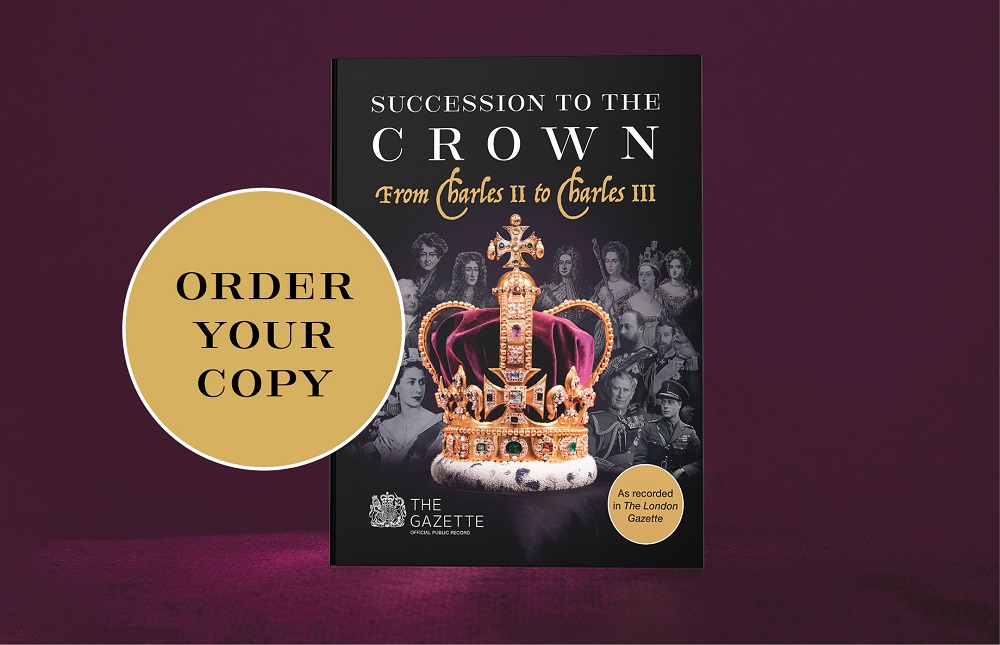
Succession to the Crown: From Charles II to Charles III
Succession to the Crown is essential reading for anyone with a keen interest in the British royal family and provides an excellent and trusted source of information for historians, researchers and academics alike. The book takes you on a journey exploring the coronations, honours and emblems of the British monarchy, from the demise of King Charles II in 1685, through to the accession of King Charles III, as recorded in The London Gazette.
Historian Russell Malloch tells the story of the Crown through trusted, factual information found in the UK's official public record. Learn about the traditions and ceremony engrained in successions right up to the demise of Queen Elizabeth II and the resulting proclamation and accession of King Charles III.
Available to order now from the TSO Shop.
About the author
Russell Malloch is a member of the Orders and Medals Research Society and an authority on British honours. He authored Succession to the Crown: From Charles II to Charles III, which explores the coronations, honours and emblems of the British monarchy.
See also
Demise of the Crown: #1: An introduction
The Order of The Bath: Prime ministerial K.C.B.s
Find out more
Succession to the Crown: - From Charles II to Charles III (TSO shop)
The Air Navigation (Restriction of Flying) (State Visit by the President of the United States of America) Regulations 2025 (Legislation)
Images
- Photograph of HM Queen Elizabeth II standing alongside King Olav V of Norway (1903-91) in the robes of the Order of the Thistle. The Duke of Edinburgh stands in the background. (Royal Collection Trust / © His Majesty King Charles III 2026)
- HRH Prince Philip, Duke of Edinburgh (1921-2021); Queen Juliana of the Netherlands (1909-2004); HM Queen Elizabeth II (b. 1926) and The Prince Bernhard of the Netherlands (1911-2004). Photograph taken in the Grand Reception Room at Windsor Castle during the State visit to Britain of Queen Juliana and Prince Bernhard. (Royal Collection Trust / © His Majesty King Charles III 2026)
- King Victor Emmanuel III of Italy rides in a carriage alongside King George V of the United Kingdom during a state procession in London in 1924. (Royal Collection Trust / © His Majesty King Charles III 2026)
- The Gazette
Publication date
13 April 2026
Any opinion expressed in this article is that of the author and the author alone, and does not necessarily represent that of The Gazette.