
Following the state visit of the American president in 2025, in a ten-part series historian and honours expert Russell Malloch looks at the recent history of state visits in the UK. In this article, he explores military content and honorary ranks and appointments to armed forces during state visits.
Chapters
The programme for the state visits of foreign monarchs and presidents to the United Kingdom have always had a strong military content, with the ceremonial including the provision of guards of honour and gun salutes, and sometimes a plan to take part in parades and inspections of units of the armed forces. There were also a few instances of the visitor being granted a high rank in the British army, navy and/or air force.
The most solemn military aspect of the state visit was the commemoration of the sacrifices that were made by the men and women of the armed forces who served during the major wars of the 20th century, and were recalled by the poppy brooch the American president Donald Trump gave to Queen Elizabeth II in 2019, the year of the 75th anniversary of the Normandy landings.
The laying of wreaths by heads of state to honour soldiers, sailors and airmen was introduced shortly after the end of the 1914-18 war, and followed an earlier series of events that were organised to mark the demise of the crown. Emile Loubet of France set a precedent for the practice in 1903, when he visited the Royal Mausoleum at Frogmore to pay tribute at the tomb of Queen Victoria, as did the kings of Portugal in 1904 and 1909 and President Fallieres in 1908.
The Edwardian ceremony was replaced by a more sombre event, which often took place on the first day of their visit, after the exchange of honours, and in advance of the state banquet. The shift in emphasis from lamenting the passing of sovereigns to the slaughter of soldiers was a consequence of the first world war, and began with a wreath being laid at the Cenotaph in Whitehall on Armistice Day in November 1919, on behalf of Raymond Poincare of France during the president’s state visit.
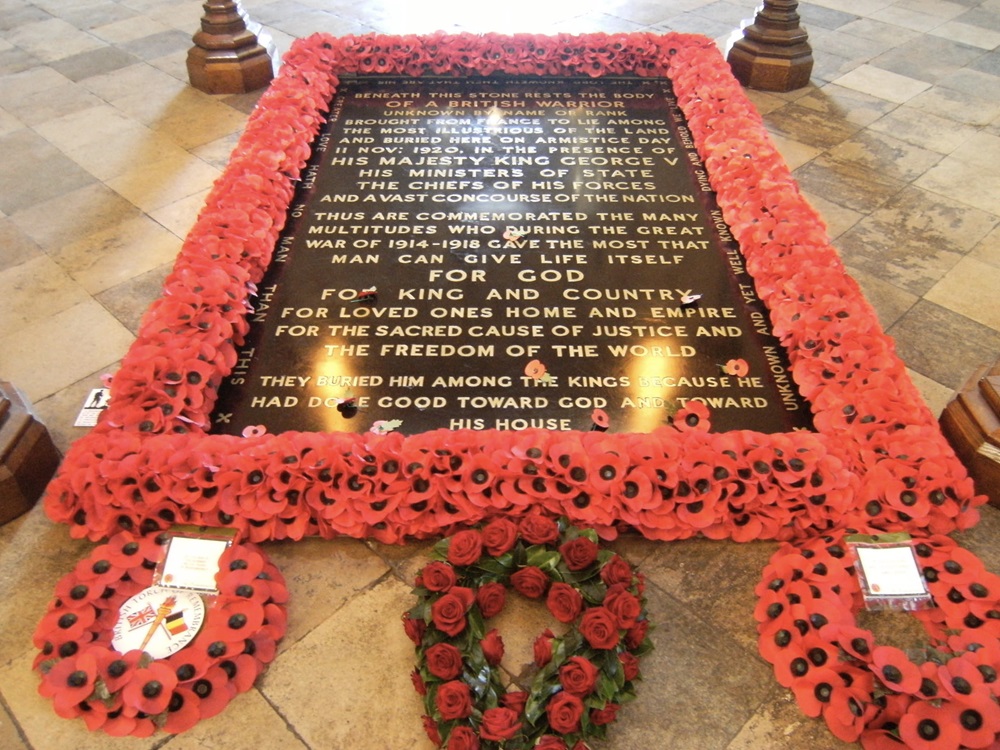
Unknown Warrior
Westminster Abbey rather than the Cenotaph became the principal focus for later events, as the abbey housed the grave of the Unknown Warrior, who was given a state funeral on Armistice Day in 1920.
The first state visitor to place a wreath on the warrior’s tomb was Crown Prince Hirohito of Japan in 1921, who set a precedent that was repeated in connection with most of the state visits during the century and more that has followed. Even so, the Court Circular recorded a few occasions when no wreath appears to have was placed by or on behalf of the monarch or president, including the state visits by Hu Jintao of China in 2005, King Abdullah of Saudi Arabia in 2007, and Pratibha Patil of India in 2009.
The programme for the American state visits had a mixed content as regards the Unknown Warrior, as George Bush, Barack Obama and Donald Trump went to the abbey in 2003, 2011 and 2019, but the grave did not receive a second wreath from President Trump in 2025.
The decision to honour the memory of the Unknown Warrior raised difficult issues in connection with the presence of visitors from nations that were at war with the United Kingdom, especially during the 1939-45 conflict. Where former protagonists later forged more stable relationships, and perhaps faced new common enemies, it was decided that it would make political sense to invite the visitor to engage in the Westminster Abbey ritual, which Theodor Heuss of Germany and Giovanni Gronchi of Italy did in 1958, and – perhaps most controversially of all – Emperor Hirohito did in 1971, just 30 years after the Japanese attack on Pearl Harbour.
The sacrifices of war were recalled in other parts of the realm which occasionally featured in the state visit circuit, with wreaths being laid at the Scottish National War Memorial at Edinburgh Castle by Kings Olav of Norway in 1962 and Carl Gustaf of Sweden in 1993, and by Roman Herzog of Germany in 1998.
War memorials
The agenda for several visits included the foreign head of state paying marks of respect to war-time events in a variety of ways other than by honouring the Unknown Warrior. In the first three decades of the 21st century, for example:
- Vladimir Putin laid a wreath at the Soviet World War II Memorial in London
- Aleksander Kwasniewski went to the Polish War Memorial at Northolt, and met war veterans
- King Harald of Norway met military veterans to mark the 60th anniversary of the liberation of his country from German occupation
- Abdullah Gul visited the memorial in the Turkish Naval Cemetery at Gosport, before lunching with the second sea lord on HMS Victory
- Yoon Suk Yeol went to the Korean War Memorial at Victoria Embankment, and received veterans of that war
Some of the state visitors acknowledged the life of Britain’s war-time leader, Winston Churchill, as in 1993 when Antonio Soares of Portugal visited Bladon Church and laid a wreath on Churchill’s grave, before having tea with the Duchess of Marlborough at his birthplace, Blenheim Palace. The same occurred in 2025 when Emmanuel Macron of France laid a wreath at Churchill’s statute in Parliament Square, after he had paid his respects to the Unknown Warrior, and before going to Carlton Gardens to honour the statute of General de Gaulle and to meet veterans.
Other wars and service operations were noticed as well as the two world wars, as in 1995 when the Emir of Kuwait met veterans of the Gulf War.
Armed forces
The head of state often witnessed displays by members of the armed forces, and toured operational bases, as well as taking part in ceremonies at the Royal Military Academy at Sandhurst and the Royal Naval Air Station at Yeovilton, and visiting Royal Air Force establishments at places such as Cranwell, Duxford and Odiham.
Some visitors learned about the work of organisations such as the Imperial War Museum in London, where in 1997 Ezer Weizman of Israel presented items from the collection of Yad Vashem in Jerusalem as a contribution to the Holocaust Exhibition, and in 1998 Roman Herzog of Germany saw an exhibition about the Berlin Airlift. The Churchill War Rooms in central London were included for visitors such as Donald Trump in 2019.
Barack Obama departed from the more formal style of military engagements in 2011, when he attended a barbeque for members of the American armed forces in the garden of the prime minister’s residence at 10 Downing Street, while Donald Trump’s 2019 visit included events connected with the 1944 D-Day landings, and he witnessed displays by the Red Arrows and the Red Devils in 2025.
The Court Circular referred to some other military occasions, as with the return of the colours of the Russian Life Guards Grenadier Regiment by Vladimir Putin at Buckingham Palace in 2003, and the presentation of the colours of the disbanded Irish Regiments by Michael Higgins when he came to Windsor Castle in 2014.

Honorary rank
A few heads of state were given an honorary rank or appointment in one of three branches of the British armed forces to coincide with their state visit. Such appointments were limited to monarchs, and no republican leader was ever given a high rank.
Edwardian examples of service rank being linked to state visits include the appointment of King Gustaf of Sweden to be an admiral in the Royal Navy to mark his 1908 visit (Gazette issue 28192), a few months after Emperor Nicholas of Russia became an admiral of the fleet (and wore his British naval uniform when King Edward visited Reval in 1908).
Many years later, a naval theme was added to the 1962 programme for King Olav of Norway, who inspected vessels of the Royal Navy’s Scotland Command and toured the Fairfield shipyard in Glasgow, while his 1988 state visit included a trip to the naval base at Portsmouth, and lunch with the commander-in-chief of Naval Home Command on HMS Victory, where he received his commission as an admiral of the fleet (Gazette issue 51297).
A few army appointments were sanctioned in this context, as King Alfonso of Spain’s arrival in 1905 was marked by the Spanish monarch being named as the colonel in chief of the 16th (The Queen’s) Lancers (Gazette issue 27802), less than a month after he was made a general in the British army (Gazette issue 27795).
A small number of other visitors held positions in army units, with the state visit being used to mark the connection between the guest and the regiment. During George VI’s reign this aspect of the state schedule was demonstrated by the review of the 5th Royal Inniskilling Dragoon Guards by King Leopold of the Belgians in 1937, not long after he became their colonel-in-chief (Gazette issue 34384). Similar links between foreign visitors and British regiments were celebrated in 1951, when King Frederick of Denmark reviewed the Buffs (Gazette issue 38152), and King Haakon of Norway met the Green Howards (Gazette issue 35555), the two army units of which they were the colonels in chief.
In 1960 the most senior army rank was conferred on King Mahendra of Nepal, who was presented with a baton on his appointment as a field marshal (Gazette issue 42168) on the day he arrived at Buckingham Palace in 1960 (when he invested the Duke of Edinburgh with the Order of Ojaswai Rajanya). The military theme continued during that visit, as the Nepalese monarch reviewed a contingent of the Brigade of Gurkhas and the Gurkha Brigade Association in the garden of Buckingham Palace, in the presence of Field-Marshal the Viscount Slim, the former chief of the Imperial General Staff, and colonel of the 1st Gurkha Rifles. Shortly afterwards King Mahendra laid a wreath on the Commando War Memorial at Spean Bridge in Scotland.
The field-marshal’s baton was not employed again for state visit purposes, but in 1994 King Harald of Norway received his commission as an honorary general in the British army at the Palace of Holyroodhouse, from the chief of the Defence Staff, and later that day he laid a wreath at the Scottish National War Memorial in Edinburgh Castle.
As regards air force appointments that were linked to state visits, the second highest rank of air chief marshal was given to the Shah of Iran in 1959 (Gazette issue 41699), to supplement the military GCB and Royal Victorian Chain he received in the 1940s. The same Royal Air Force rank provided a method of adding to the existing honours of the Sultan of Brunei in 1992 (Gazette issue 53103), as he had previously received the GCMG and the rank of general (Gazette issue 49658).
Succession to the Crown: From Charles II to Charles III
Succession to the Crown is essential reading for anyone with a keen interest in the British royal family and provides an excellent and trusted source of information for historians, researchers and academics alike. The book takes you on a journey exploring the coronations, honours and emblems of the British monarchy, from the demise of King Charles II in 1685, through to the accession of King Charles III, as recorded in The London Gazette.
Historian Russell Malloch tells the story of the Crown through trusted, factual information found in the UK's official public record. Learn about the traditions and ceremony engrained in successions right up to the demise of Queen Elizabeth II and the resulting proclamation and accession of King Charles III.
Available to order now from the TSO Shop.
About the author
Russell Malloch is a member of the Orders and Medals Research Society and an authority on British honours. He authored Succession to the Crown: From Charles II to Charles III, which explores the coronations, honours and emblems of the British monarchy.
See also
Demise of the Crown: #1: An introduction
Find out more
Succession to the Crown: - From Charles II to Charles III opens new window (TSO shop)
Images
- Tomb of the Unknown Warrior, Westminster Abbey. (Mike from England)
- King Edward VII and Nicholas II, Emperor of Russia inspecting naval officers on the deck of a yacht in the Bay of Reval. (Royal Collection Trust / © His Majesty King Charles III 2026)
- The Gazette
Publication date
17 February 2026
Any opinion expressed in this article is that of the author and the author alone, and does not necessarily represent that of The Gazette.