
When did the first copy of the Declaration of Independence arrive in Britain? Graham Moore, a Records Specialist for Early Modern Parliament at The National Archives, looks at the ‘Dunlap broadsides’ and how news of US Independence spread across the Atlantic.

Independence in The Gazette
On 10 August 1776, The London Gazette published a letter from general William Howe, then commander-in-chief of the British Army in North America, to George Germain (Secretary of State for the Colonies). In this letter, dated 7 July, Howe was reporting his progress in fighting the ongoing rebellion in America. He also told Germain: “I am informed that the Continental Congress have declared the United Colonies free and independent States”. Just over a month since its first publication in Philadelphia on 4 July, this was the first time the US Declaration of Independence had been reported in a European newspaper.
This publication (Gazette issue 11690) effectively announced the existence of the United States of America to the rest of the world. With the benefit of hindsight, this was a landmark moment in world politics – but at the time, distribution of the Declaration outside the rebellious Thirteen Colonies was a fairly minor concern. The document’s primary audience was not people in Britain, but demoralised rebels and any colonists with as-yet undecided loyalties in British America. It was designed to rally support for a shared struggle by all the Thirteen Colonies, and mark a point of no return – a “do or die” moment for the rebellion in British America.
This was a major event in British, as well as American, history. It’s also a story about news and communication in the eighteenth century – and the circuitous routes information might take as documents like the Declaration of Independence crossed oceans and changed the world.
The notification in The London Gazette is only half the story of how the Declaration came to Britain. The surprising fact is this: although the Declaration of Independence directly affected Britain, and levelled accusations of “Tyranny” against King George III, no copy was ever sent directly to Britain by the Continental Congress which had ratified it. Instead, the several copies now held at The National Archives in Kew – which holds the largest single collection of original 4 July ‘Dunlap broadside’ prints of the Declaration – were all sent back to Britain by British officers and officials, who had collected them in course of their operations in North America.
The first US Declaration in Britain
The first copy of the Declaration of Independence to arrive in Britain reached London on 3 September 1776, nearly a month after The Gazette had first reported Congress’ decision to produce the document – and nearly two months since the initial Declaration on 4 July. Although this time delay seems large, it is not surprising: a typical sea passage from the Thirteen Colonies to Britain could take 3 to 4 weeks, whilst the westward journey could take up to twice as long. This copy of the Declaration was at sea for about a month, having been enclosed in a letter to George Germain in London from Lord Dunmore (John Murray), the governor of Virginia, dated 31 July.
As well as being notable as the first copy of the Declaration to arrive in Britain, Dunmore’s enclosure illustrates the way in which news of the Declaration had spread around British America. By the end of July, the Declaration had already impacted Dunmore’s operations in Virginia. Dunmore had been pushed out of Virginia’s colonial capital of Williamsburg by a committed and well-organised rebel militia, and was fighting a doomed rearguard action from his floating headquarters on a ship in the Potomac River. In his letter, he wrote that the rebels were inspired by the Declaration and had already set in motion a new constitution for the colony: “the Virginians have altered their Constitution into a Strange Motley, which they call a Commonwealth”. He also anticipated that news of the Declaration would already have reached London (which it had, in The Gazette). He wrote that he was enclosing the copy “Least your Lordship should not have seen the Resolution of the Congress relative to Independency”.
The copy enclosed by Dunmore has its own interesting journey. The Declaration’s first print run had been produced in Philadelphia, at the urgent request of the rebel Continental Congress on the night of 4 July, by a printer named John Dunlap. These first versions are often called the ‘Dunlap broadsides’. Dunlap printed approximately 200 copies, only 26 of which remain today – 3 of which are stored in The National Archives in the UK.
However, Dunmore’s copy was not one of those official ‘Dunlap broadsides’. Instead, its attribution states that whilst it was also printed by John Dunlap, it was distributed from Dunlap’s other printing shop, located in Baltimore. Then, some time between its printing in early July and its enclosure by Dunmore on 31 July, it had travelled over 400 miles to the Potomac River in Virginia. This numbers it amongst the hundreds, if not thousands, of copies of the Declaration that must have been traversing the Thirteen Colonies by the end of July 1776, as the news of US independence snowballed and distributors across the rebel colonies reprinted the Declaration’s text in newspapers and other formats. Dunmore’s inclusion of that copy of the Declaration in his letter to Germain marked the next stage, as the text’s distribution jumped the Atlantic and spread to Britain itself.
This was a landmark moment for transatlantic news – but it was also business as usual for the British Empire. Dunmore enclosed the Declaration alongside a copy of that new Virginia constitution, emphasising that the Declaration was just one of many items crossing the Atlantic as part of the British state’s intelligence-gathering process. Military officers and colonial officials frequently included a variety of enclosures in their regular correspondence with their superiors in London.
These enclosures – which might include newspapers, intercepted letters, and other ephemera – allowed British officials to justify their own decisions. The Atlantic Ocean separated Dunmore from Germain, his direct superior, not only by thousands of miles of saltwater but also by a significant time delay. Because officials (and military officers) in colonial North America could expect to wait two months or more for a reply to their letters, they were expected to act on their own initiative – but they were still accountable to their superiors after the fact. Dunmore, in particular, was aware that he was failing to hold Virginia against the rising rebellion. By enclosing the Declaration and other relevant papers, he was indicating all the ways in which the deck might appear stacked against him.

The Declaration and military intelligence
Dunmore was not the only person to enclose a copy of the Declaration for this purpose – indeed, he was not even the first. Although Dunmore’s copy sent on 31 July was the first to arrive in London (on 3 September), the first copy sent across the Atlantic was an original ‘Dunlap broadside’ that had been enclosed in a letter three days earlier on 28 July. This letter was sent by vice-admiral Richard Howe (brother to general William Howe) and addressed to the Admiralty Secretary, Philip Stephens. Although sent just before Dunmore’s copy, this Declaration would not arrive in London until almost a month later on 28 September.
Vice-admiral Howe was commanding the Royal Navy’s fleet in North America. He had arrived in America to take up his command on 12 June 1776, joining the British fleet near Staten Island, New York aboard HMS Eagle (64). As well as providing naval support to the Army under his brother William, Richard’s task was to blockade British-American ports under the terms of the 1775 Prohibitory Act, which was designed to throttle the rebellion’s economic foundations. Already, the vice-admiral found himself under-resourced. Diverting the majority of his fleet to support the attack on rebel-held New York, he lamented his “Deficiency of Means” in a letter dated 28 July: “The Liverpool is the only frigate I have to spare at this Time, to place off Boston”.
It was in that same letter that vice-admiral Howe enclosed the first copy of the US Declaration despatched to Britain. He wrote:
“I have added hereto a Copy of the Declaration issued by the American Congress the 4th of this Month, and a New-York Paper containing the Constitution framed in Consequence in the Provinces of Jersey and Virginia. Similar Establishments are said to have lately taken place at New York and Rhode Island.”
Howe, like Dunmore, was enclosing a copy of the Declaration as part of his own role in the British intelligence-gathering process – this time feeding into the Royal Navy’s military intelligence. This highlights a second reason that British officers and officials might include enclosures in their correspondence: to advise policy and strategy decisions in Britain’s central government and military command. For example, information about whether different colonies were embracing or rejecting Congress’ Declaration of Independence would advise British military deployment in North America, which hoped to capitalise on a groundswell of support from Loyalists who might fight on the British side. Meanwhile, colonies who responded keenly to the Declaration were more likely to be raising strong militias, recruiting for Washington’s Continental Army, and outfitting privateers for the nascent Continental Navy. This information would affect Howe’s short-term decision-making in North America, but it would also advise long-term military strategy back in London that influenced the distribution of resources across the British Empire in totality.
A newsworthy Declaration
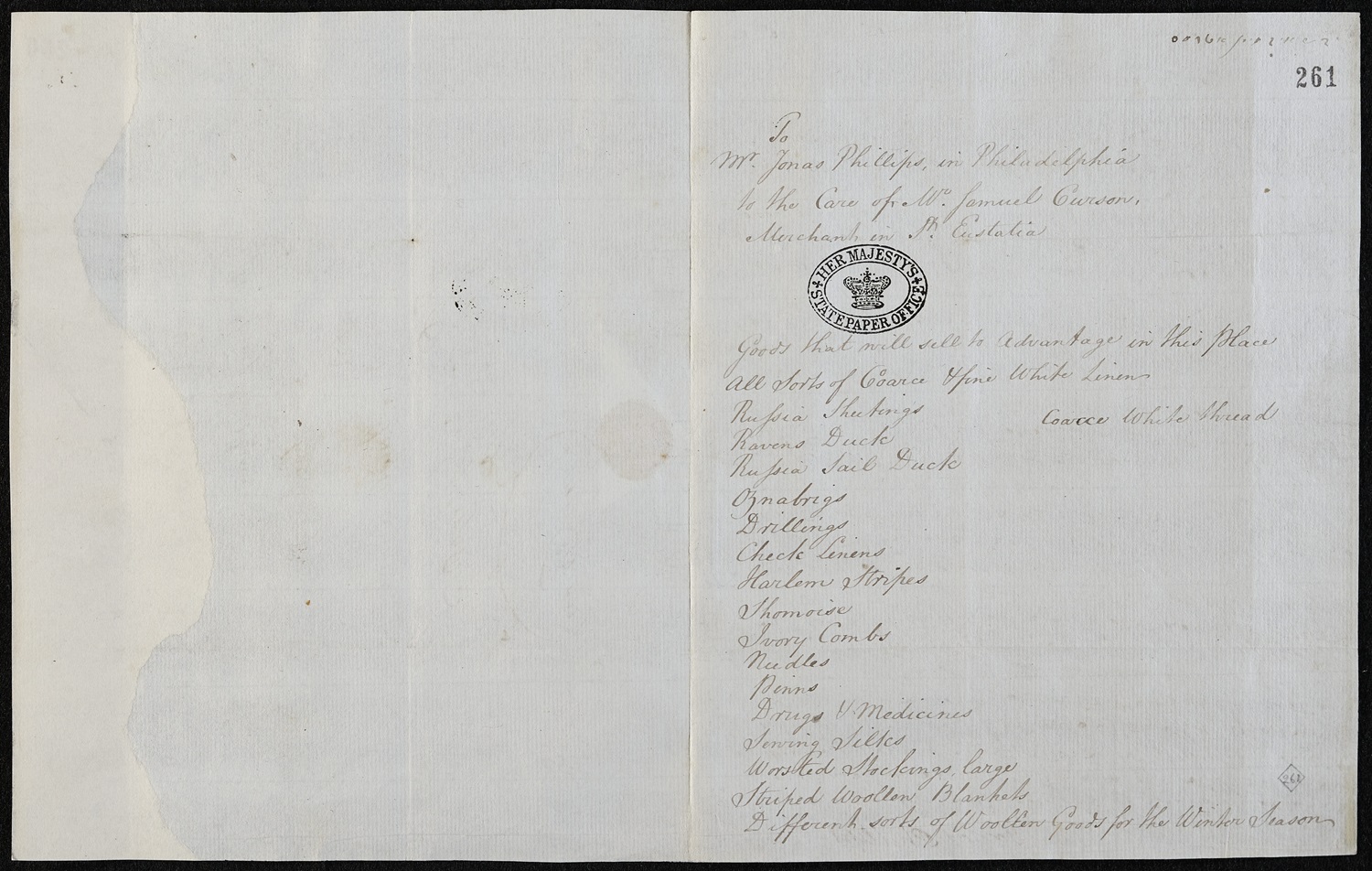
British officers and the editors of The London Gazette were not the only people who deemed the US Declaration of Independence newsworthy. This is well illustrated by the journey of another ‘Dunlap broadside’ now at The National Archives, which was initially enclosed in a private letter dated 24 July 1776 by one Jonas Phillips, a Jewish merchant living in Philadelphia. This postage date actually makes Phillips’ copy of the Declaration the first we know to have been posted overseas.
Phillip’s letter was addressed to a merchant named Gumpel Samson in Amsterdam. Samson had been Phillips’ mentor, and the two seem to have engaged in frequent transatlantic correspondence, swapping tips about which goods might fetch a good price in both Europe and North America. These kinds of international relationships were common amongst early modern merchants, who maintained strong ties to colleagues around the world and established networks based on patronage and mutual benefit. Phillips’ letters – one in English and one in Yiddish – discussed the trading opportunities presented by US independence, including a healthy appetite in the rebel colonies for textiles and medicines. He enclosed a copy of the Declaration of Independence as evidence of this, and also because he believed it would be of interest to Samson and his contacts in the Dutch Republic. Phillips wrote:
“The enclosed is a declaration of independence for the whole country. How it will end, the blessed God knows. The war does me no damage, thank God!”
This kind of information would have been extremely valuable to merchants in Europe. However, Phillips had a problem: the 1775 Prohibitory Act had instituted a blockade of all ports in the rebel colonies. Direct post to Amsterdam from Philadelphia would not only have been illegal but also very risky, with a high chance of the letter being intercepted en route by the British blockade. To maximise his letter’s chances of reaching Samson, Phillips chose instead to send it via the Dutch-owned island of Sint Eustatius in the Caribbean, much frequented by blockade-runners selling arms and supplies to the rebellion in America. Phillips had a contact in Sint Eustatius named Samuel Curson, who would then forward the letter on to Amsterdam.
Despite Phillips’ precautions, his letter still ran afoul of the Royal Navy. It’s not clear from the records exactly where and when the letter was picked up but, by some time after 31 July, it, too, had fallen into the hands of Dunmore. The governor sent it onwards to London as part of a larger packet of intercepted rebel letters – another key source of information for the British government. Commenting on several letters intercepted en route between the Thirteen Colonies and Sint Eustatius, Dunmore wrote:
“It is by the West Indies that the Rebels receive all their information. It is first sent to the British West India Islands and from thence conveyed to St Eustatia with which place the Rebels have a constant intercourse, and are supplied by the Dutch with Powder and Ammunition of every kind, as well as all sorts of Dry Goods, Rum and Sugar”.
With these examples in mind, the early report of the US Declaration of Independence in The London Gazette of 10 August emerges as just the tip of the iceberg. Transmission of the Declaration, both as a text and in its physical forms, was underpinned by a larger system of transatlantic intelligence-gathering and information-sharing. In an era before instant communication, news of the Declaration was nevertheless able to spread far and wide.
The US Declaration of Independence boldly stated, “let Facts be submitted to a candid world” – but its spread around that world was driven by instances of personal ingenuity and a network of connections that criss-crossed oceans and continents.
About the author
Graham Moore is a Records Specialist for Early Modern Parliament at The National Archives opens new window, focusing on maritime and social histories, particularly in the colonial Atlantic world. He has curated Revolution 250, The National Archives’ exhibition marking the 250th anniversary of the US Declaration of Independence.
See also
250 Years of the US: Independence and The Gazette
The National Archives’ exhibition Revolution 250
Images
The National Archives
Publication date
11 June 2026
Any opinion expressed in this article is that of the author and the author alone, and does not necessarily represent that of The Gazette.